

The changing climate has urgent implications for people, the environment and for our economies
Bayer is uniquely positioned to drive mitigation, enable adaptation, and increase healthcare resilience as well as protect at-risk populations. Through science, meaningful partnerships, and a focus on health equity, we are enabling individuals and communities to adapt and shape a healthier, more resilient future for all.
Resources-
How climate is shaping health outcomes…
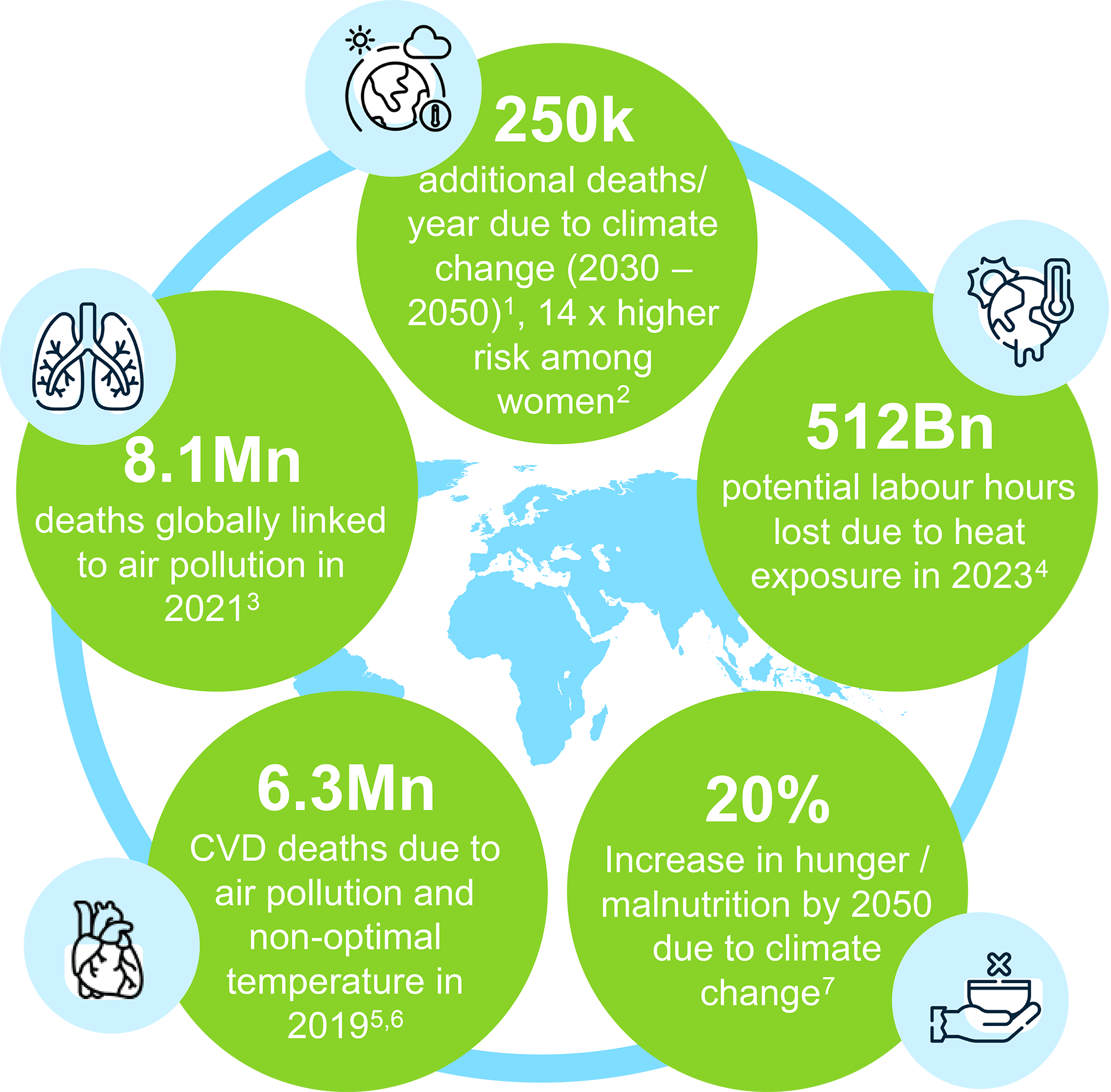
Those most at risk from
the health impacts of
climate change include
Women
People over 65
Children
People in countries of
lower-middle income
-
Bayer recognizes the multiple ways in
which climate change can impact
individual health including...
More frequent
extreme
weather events
Increased
vector-borne
diseases
Reduced access
to healthcare
Disruption of
food systems
Increased
zoonoses
Increased air
pollutionHow can Bayer make a difference?

Inform and educate healthcare professionals and patients on the health impacts of a changing climate.
Drive scientific progress to support policies, guidelines and clinical practice, to protect people with vulnerabilities to climate change.
Establish partnerships with academic and NGO organisations to strengthen and prepare healthcare systems.
-
As a global leader in
healthcare and nutrition,
Bayer is uniquely positioned to
address the health impacts of climate changeBayer is targeting four therapeutic
areas in which it is well positioned to
have an immediate impact on
individual health
Cardio-kidney-metabolic health

Infectious diseases

Respiratory health

Women's health
...and continues to work on other areas in
which it can have a long-term impact
Swipe to view more
- World Health Organization. 2014 Quantitative risk assessment of the effects of climate change on selected causes of death, 2030s and 2050s. Available at: https://iris.who.int/bitstream/handle/10665/134014/9789241507691_eng.pdf?sequence=1. Accessed Aug 2025;
- United Nations. 2022. Why women are key to climate action. Available at https://www.un.org/en/climatechange/science/climate-issues/women Accessed Aug 2025;
- Health Effects Institute. 2024. State of Global Air. Special Report. Boston, MA. Available at https://www.stateofglobalair.org/sites/default/files/documents/2024-06/soga-2024-report_0.pdf Accessed Aug 2025;
- The Lancet Countdown. Available at https://lancetcountdown.org/2024-visual-summary/ Accessed Aug 2025;
- Rajagopalan and Landrigan. N. Engl. J. Med 2021;385:1881-1892;
- Al-Kindi et al. Eur J Prev Cardiol 2023 Oct 26;30(15):1623-1631;
- World Food Programme. 2021. Climate Crisis and Malnutrition – A case for acting now. Available at https://www.wfp.org/publications/climate-crisis-and-malnutrition-case-acting-now Accessed Aug 2025.
Climate Change and Individual Health Resources
Escalating climate change is fundamentally reshaping global health landscapes, with profound implications for individuals, communities, and healthcare systems. Healthcare providers and healthcare workers are well placed to take action. Explore the links below to learn more about the relationship between climate change and health and discover how you can make a difference. These resources have been developed in partnership with key experts in the field.


Cardiovascular-kidney-metabolic diseases are exacerbated by extreme heat, cold, and air pollution. Those living in tropical climates and lower-middle-income countries are among the most affected.
Infectious diseases are spreading due to environmental changes that expand the range of disease vectors and pathogens. Antimicrobial resistance is also on the rise.
Climate change exacerbates respiratory health issues by increasing air pollution and allergens, significantly impacting at-risk groups including children and the elderly.
Climate change can impact women's health across the lifespan, from puberty to menopause and beyond. Pregnant women and children are particularly at-risk.